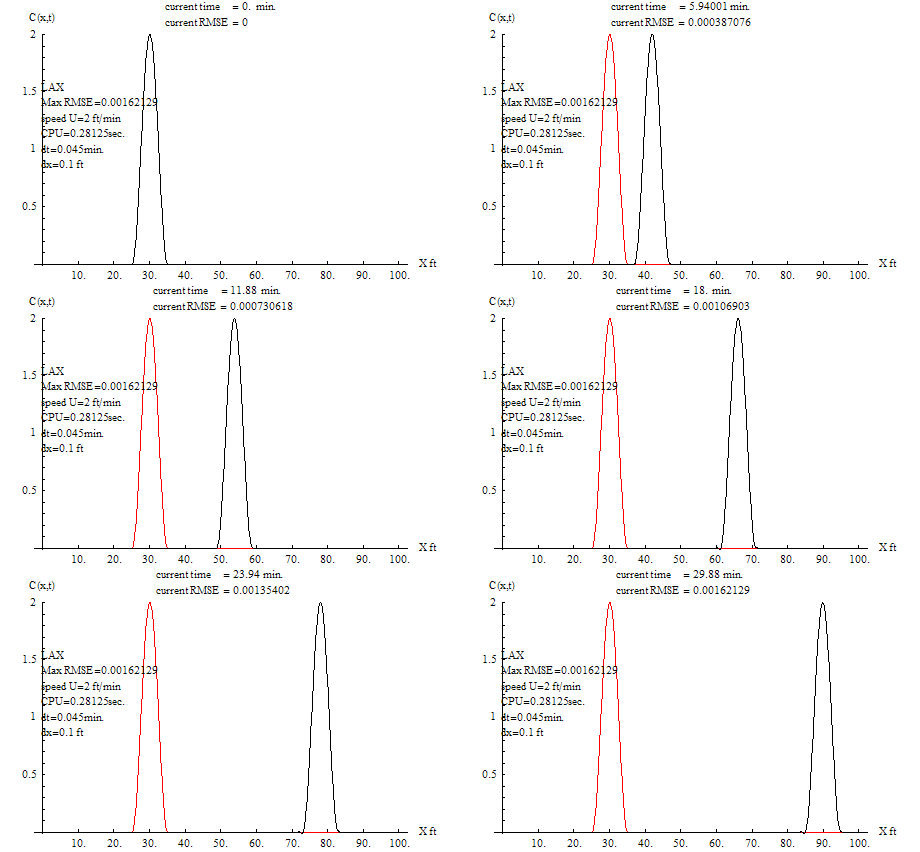
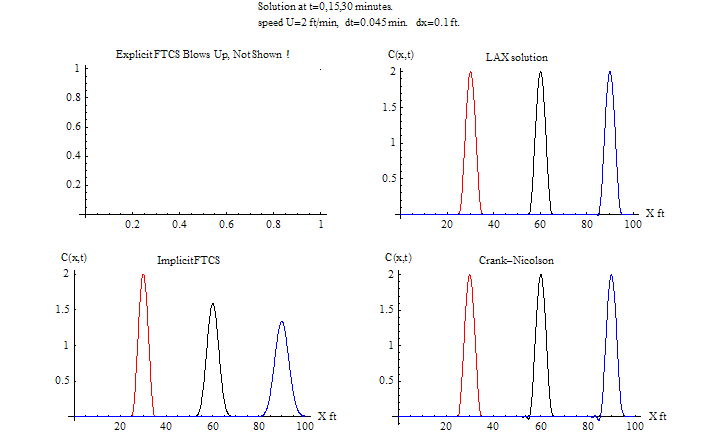
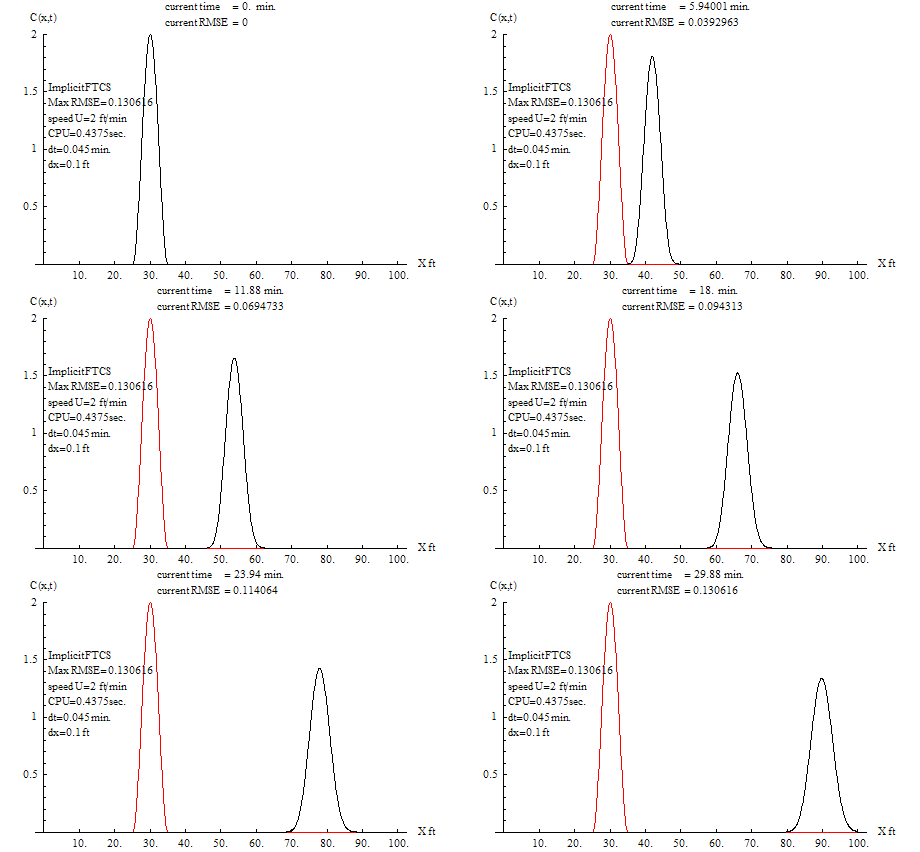
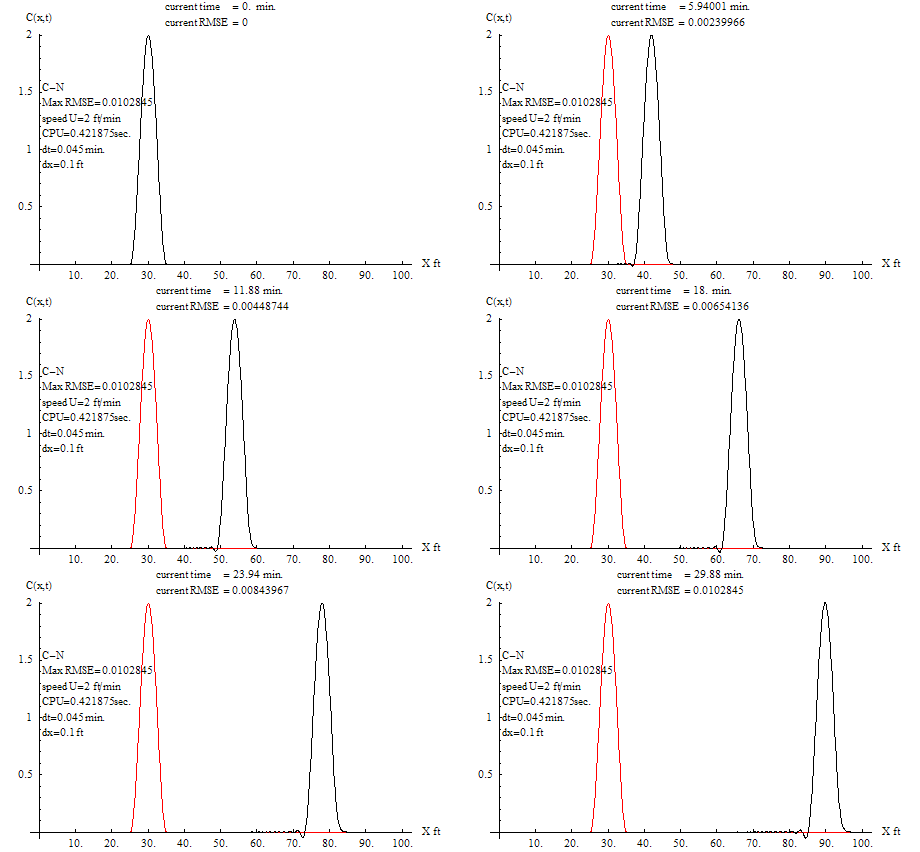
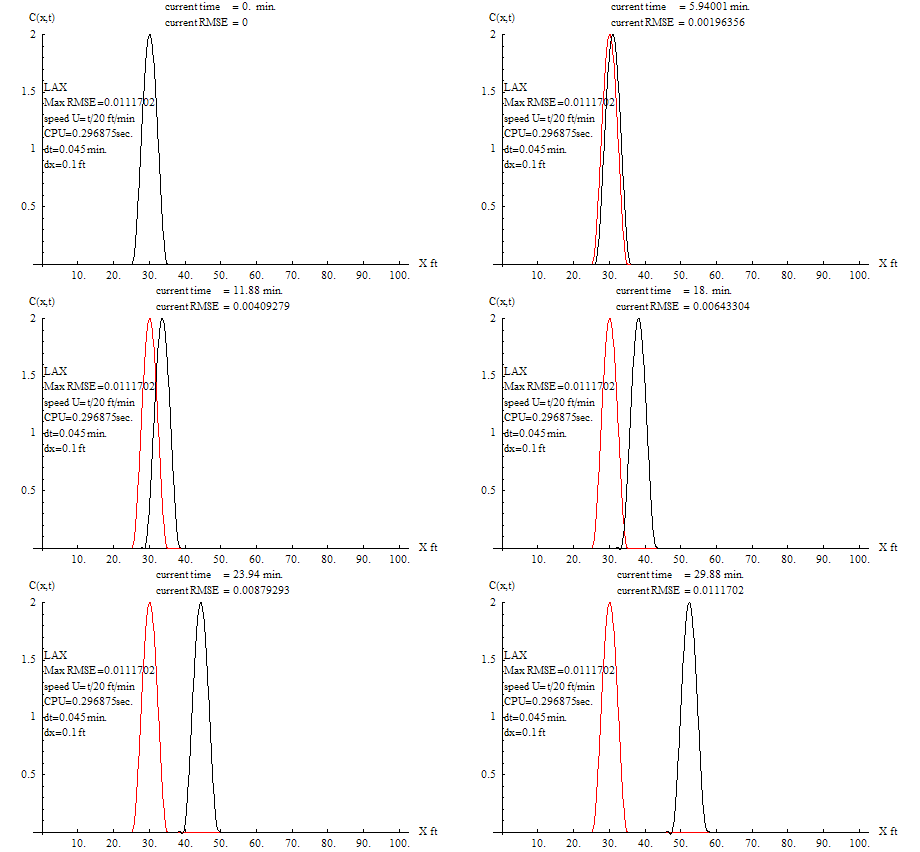
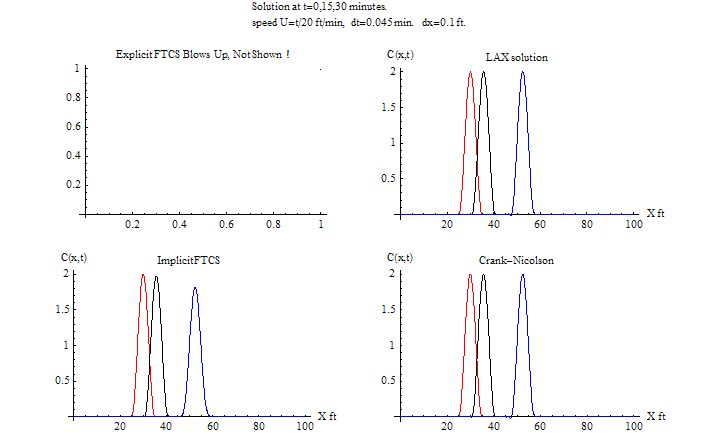
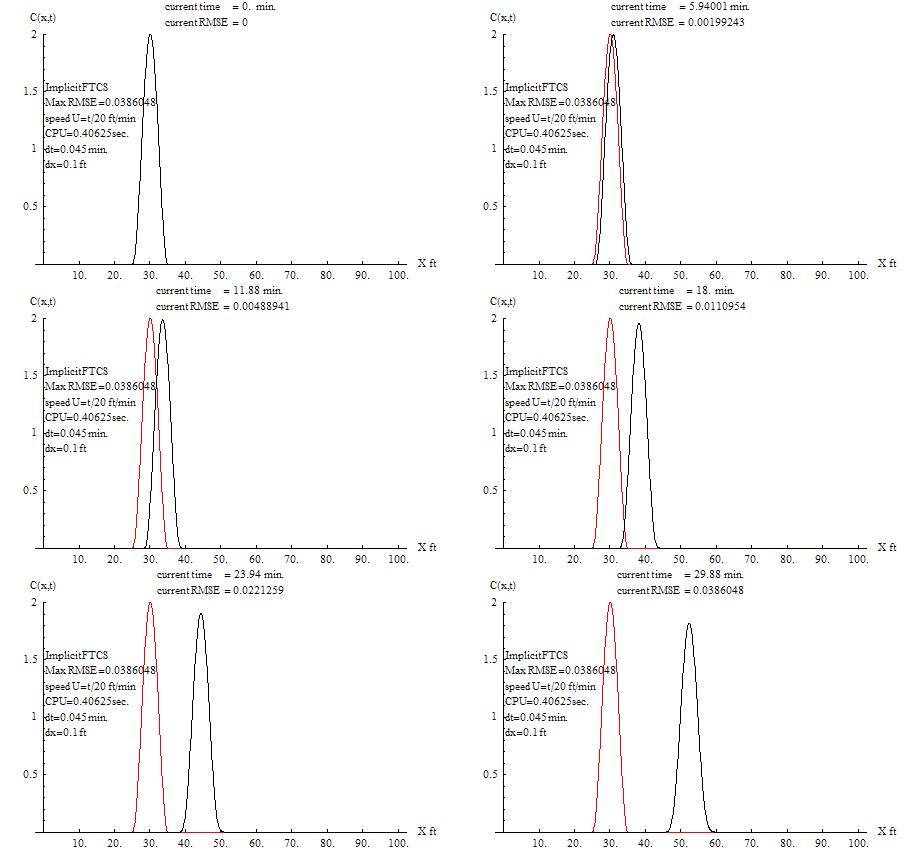
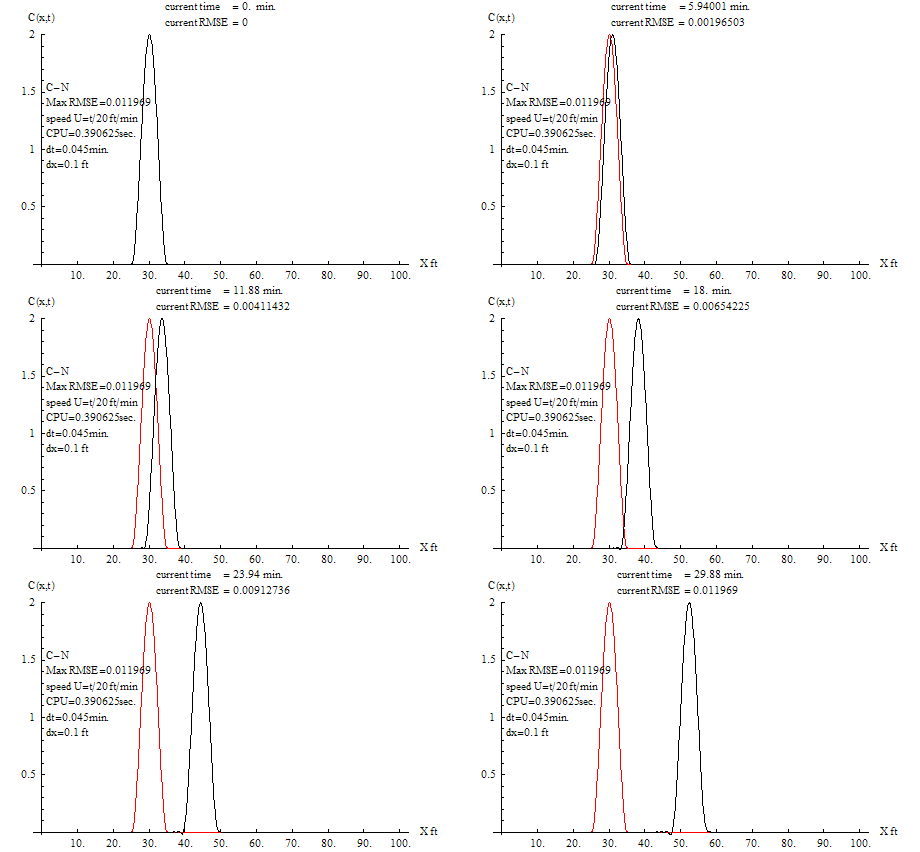

Again the time step is made longer than before. Now the explicit FTCS is completely unstable.
\(\tau =0.045\) sec, \(h=0.1\ \)ft
For the case of fixed \(U\), we have \(\frac {u\tau }{h}=\frac {2\times 0.045}{0.1}=\allowbreak 0.9\leq 1\), while for varying \(U\), the maximum value will be at the end of the run, which is \(30/20=1.5\) ft/min., hence the CFL condition is changing, with a value of \(\frac {1.5\times 0.045}{0.1}=\allowbreak 0.675\,\) at the end of the run which is still \(\leq 1\)
| Speed | Method | CPU time (sec) | RMSE | Animation (2D) | plots |
| U=2 | Explicit FTCS | 0.73 | blows up | HTML | HTML |
| Explicit LAX | 0.281 | 0.000162 | HTML | ||
| Implicit FTCS | 0.437 | 0.1306 | HTML | ||
| C-R | 0.4 | 0.01028 | HTML | ||
| U=t/20 | Explicit FTCS | 0.28 | blow up | HTML | HTML |
| Explicit LAX | 0.3 | 0.01117 | HTML | ||
| Implicit FTCS | 0.40 | 0.0386 | HTML | ||
| C-R | 0.4 | 0.01197 | HTML | ||
For the varying speed case, the explicit FTCS remained stable for the duration of the run as compared to the case with the fixed speed. This is because the average wave speed is less than with the fixed wave speed case.
The magnification factor depends on the speed of the wave.
With the varying speed case, the coefficient \(\frac {u\tau }{h}\) was smaller during the whole run, since the maximum speed \(u\) attained will be \(1.5\,\ \)ft/min. as compared to \(2\) ft/min. in the fixed \(u\) case.
If we have run the simulation a little longer for the varying speed case, we will see the instability with explicit FTCS. This below is a diagram showing 2 runs using the explicit FTCS both with \(u=\frac {t}{20}\) ft/min, one was run for 30 minutes, and the second for 53 minutes. The run to 30 minutes showed no instability while the run for 53 minutes showed the instability. This show the explicit FTCS will eventually become unstable.
This is an animation of the above HTML