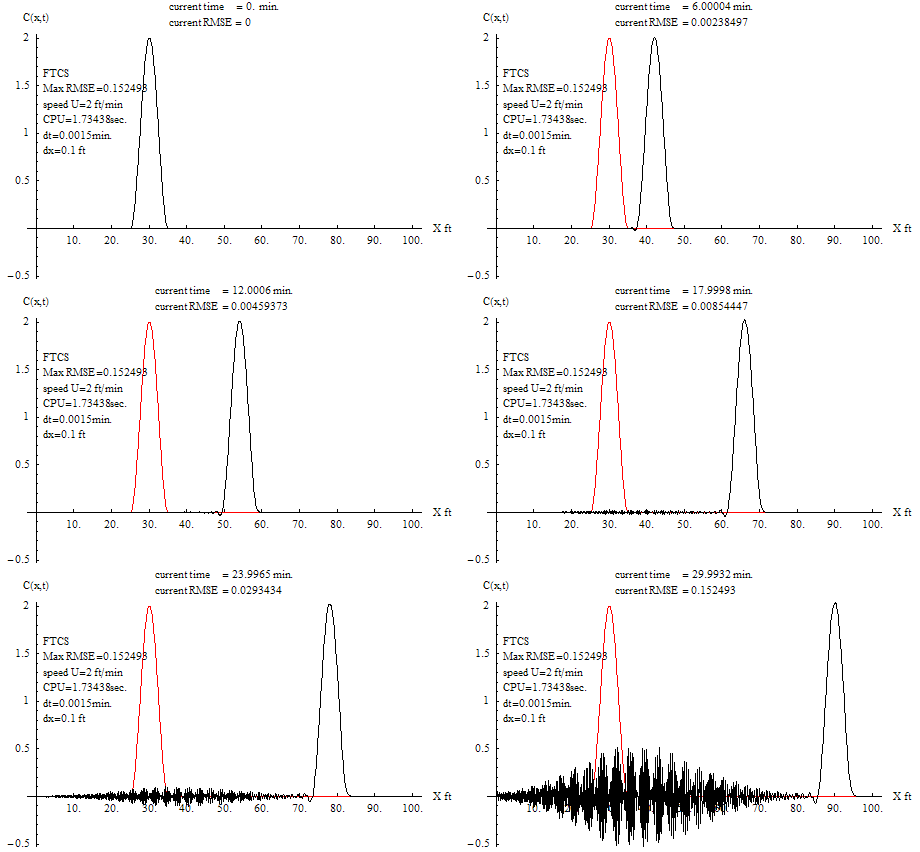
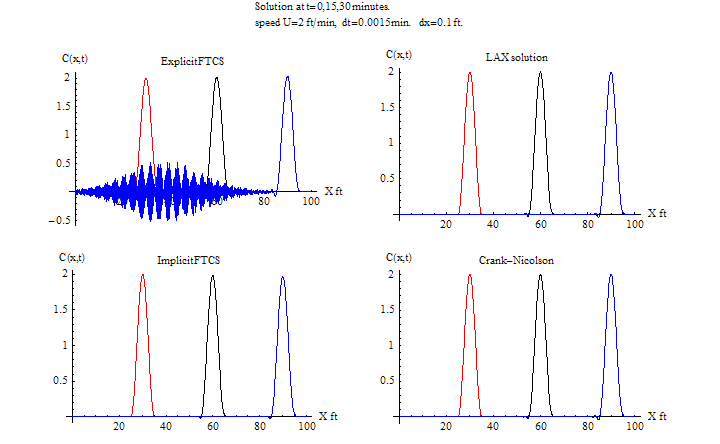
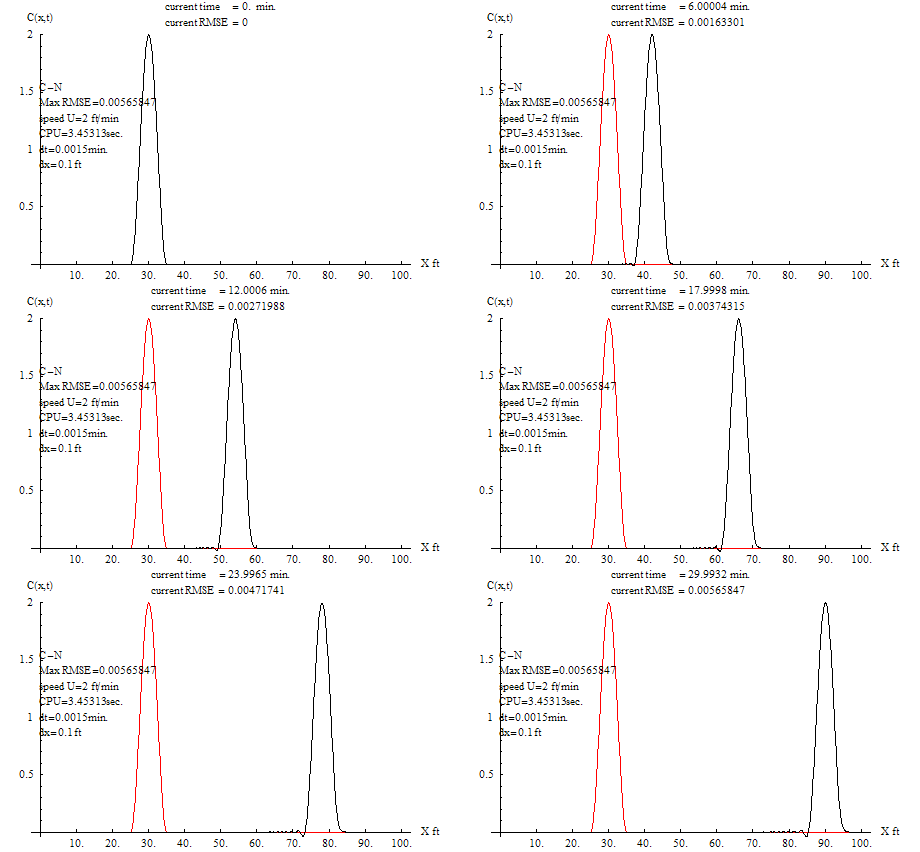
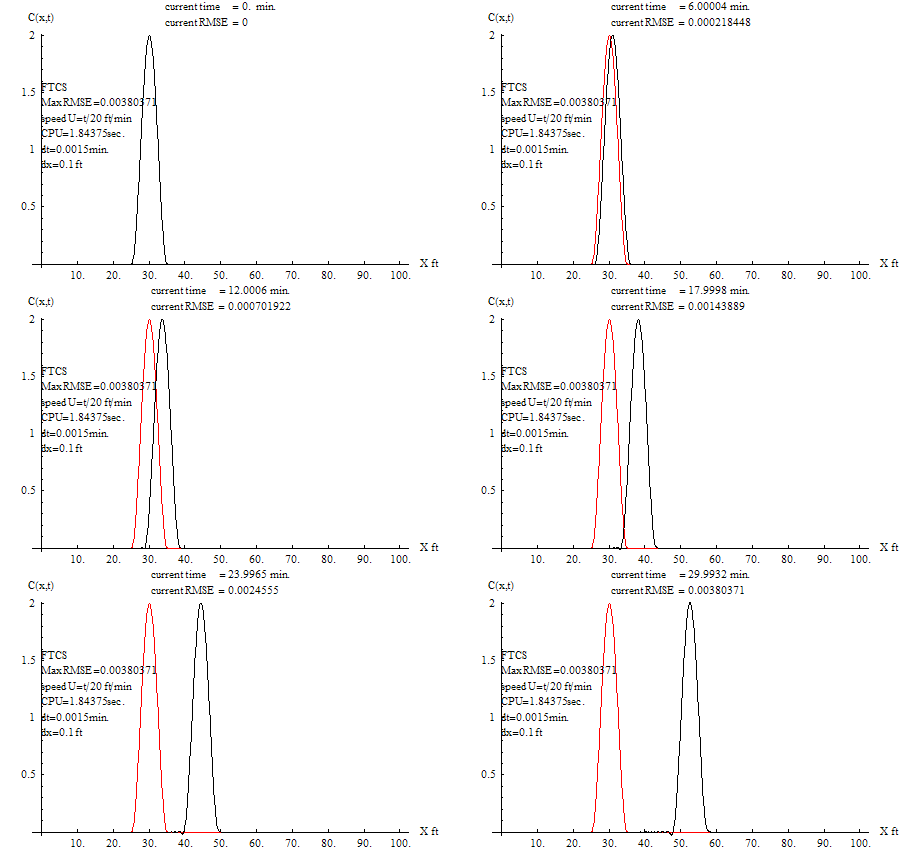
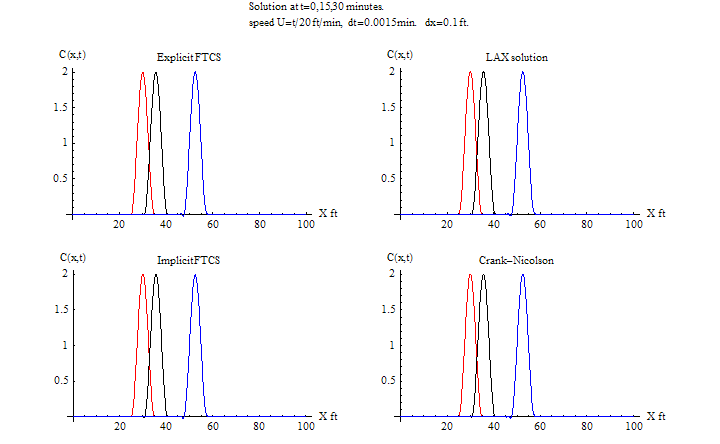
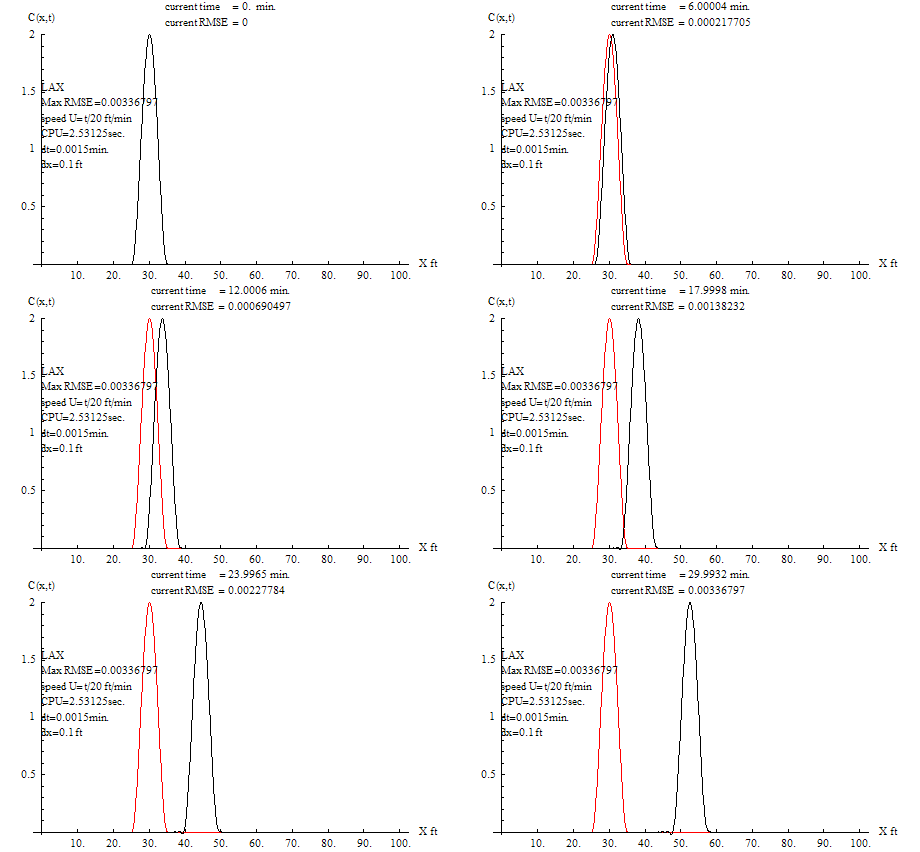
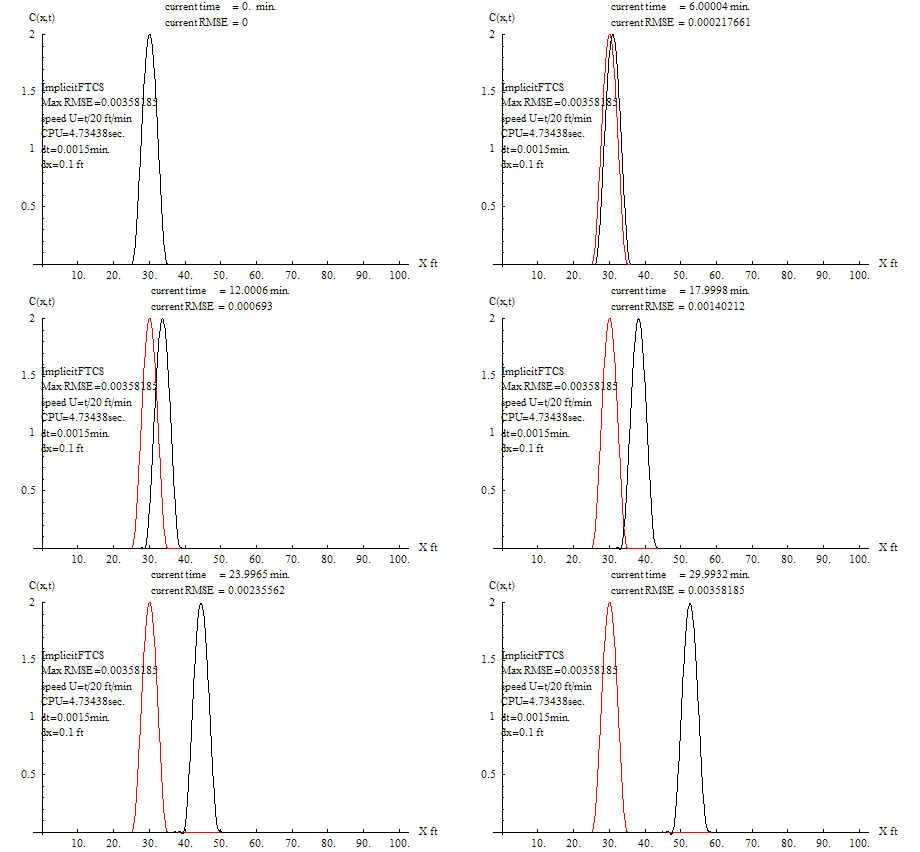
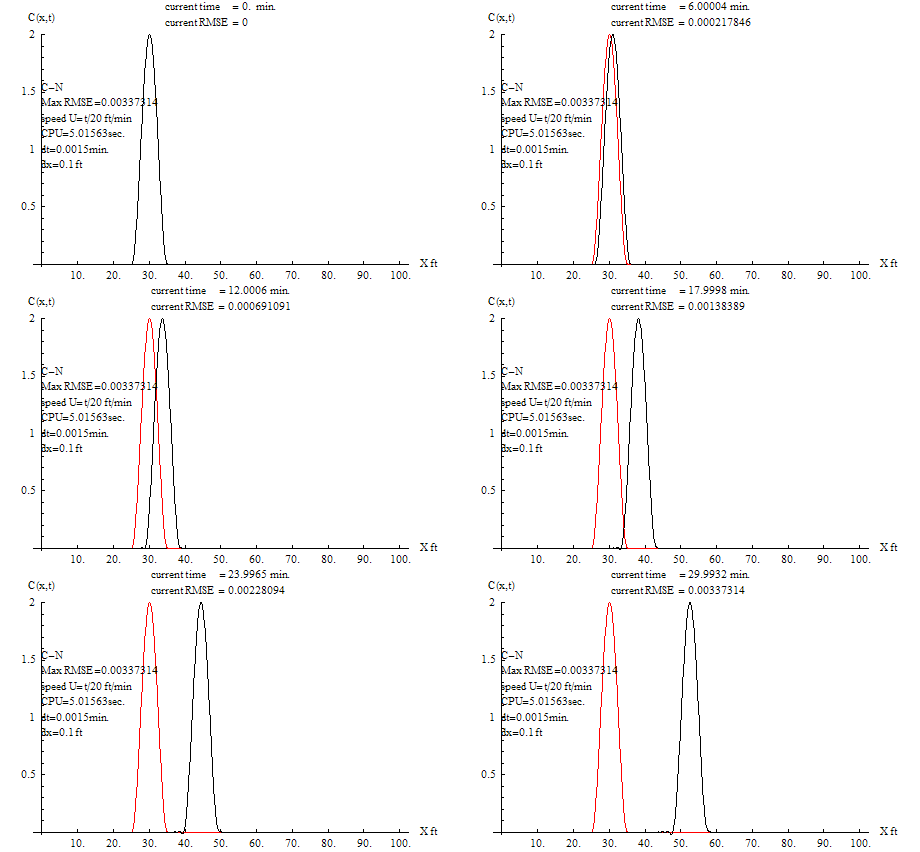
In this case, we slightly make the time step even longer than before. Now FTCS becomes more unstable.
\(\tau =0.0015\) sec, \(h=0.1\ \)ft\(,\) \(\frac {u\tau }{h}=0.03\leq 1.\)
| Speed | Method | CPU time (sec) | RMSE | Animation (2D) | plots |
| U=2 | Explicit FTCS | 1.73 | 0.15249 | HTML | HTML |
| Explicit LAX | 2.56 | 0.000563 | HTML | ||
| Implicit FTCS | 3.34 | 0.009005 | HTML | ||
| C-R | 3.45 | 0.00565 | HTML | ||
| U=t/20 | Explicit FTCS | 1.84 | 0.00380 | HTML | HTML |
| Explicit LAX | 2.53 | 0.00336 | HTML | ||
| Implicit FTCS | 4,73 | 0.00358 | HTML | ||
| C-R | 5 | 0.003373 | HTML | ||
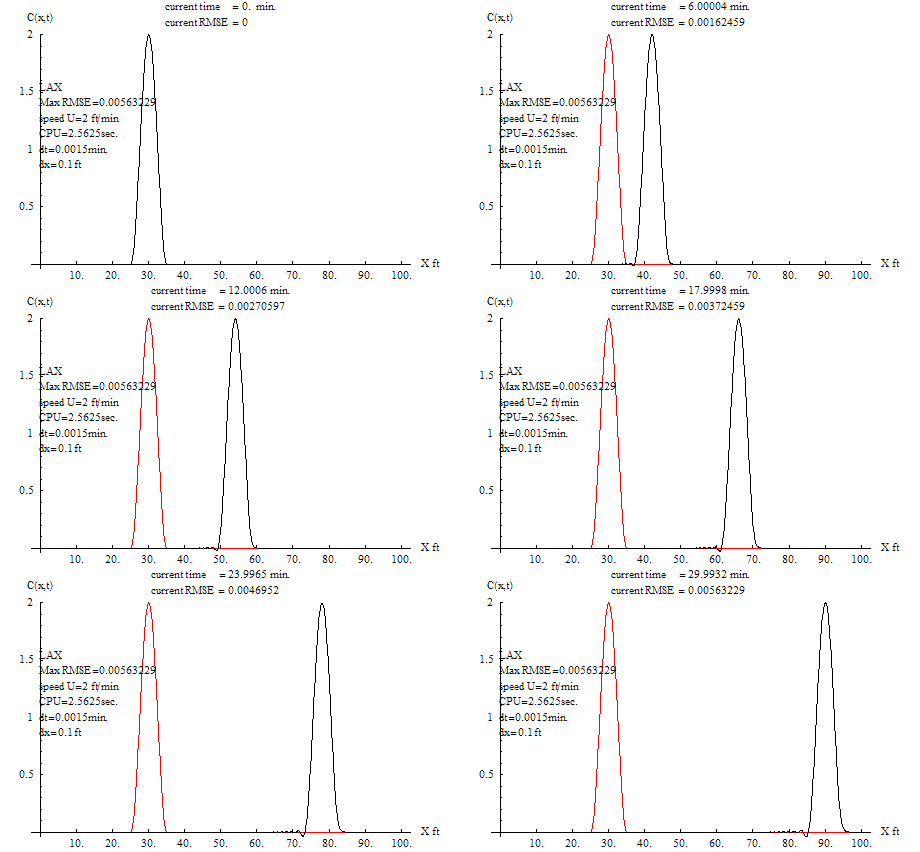
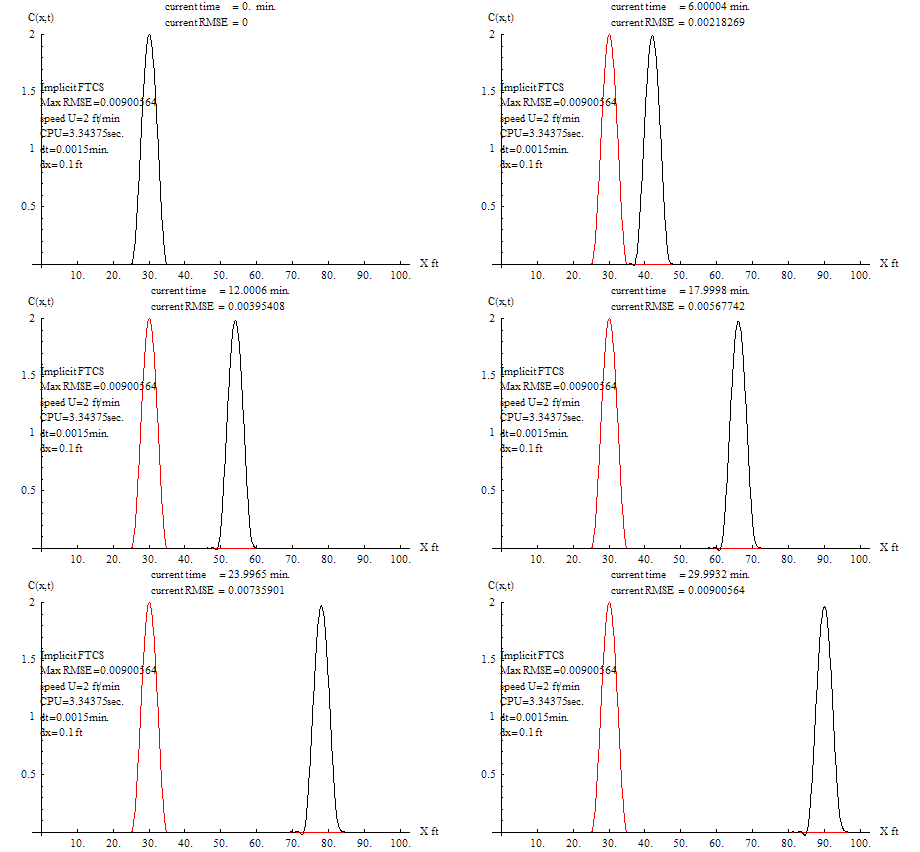
FTCS Instability starts at around 20 minutes. LAX remained stable since CFL is satisfied. Lax remained the most accurate at this time step. It accuracy actually improved as the time step became larger.