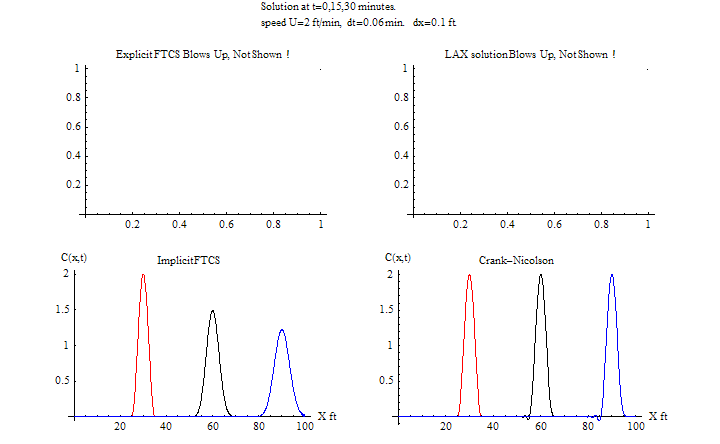
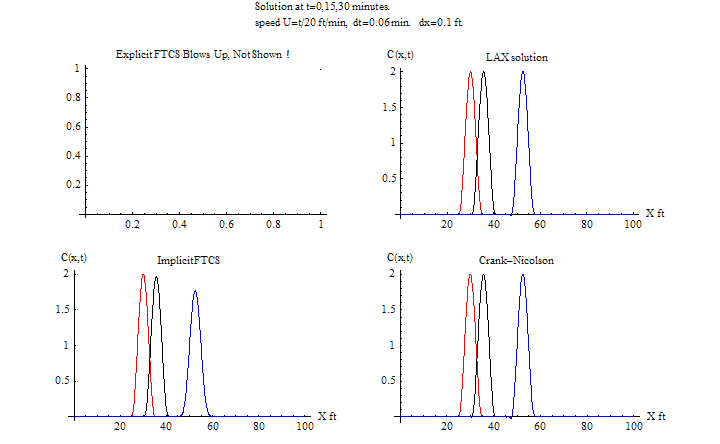
\(\tau =0.06\) sec, \(h=0.1\ \)ft\(,\) \(\frac {u\tau }{h}=\frac {2\times 0.06}{0.1}=1.2>1\)
| Speed | Method | CPU time (sec) | RMSE | Animation (2D) | plots |
| U=2 | Explicit FTCS | 0.65 | blows up | N/A blows up | HTML |
| Explicit LAX | 0.9 | blows up | HTML | ||
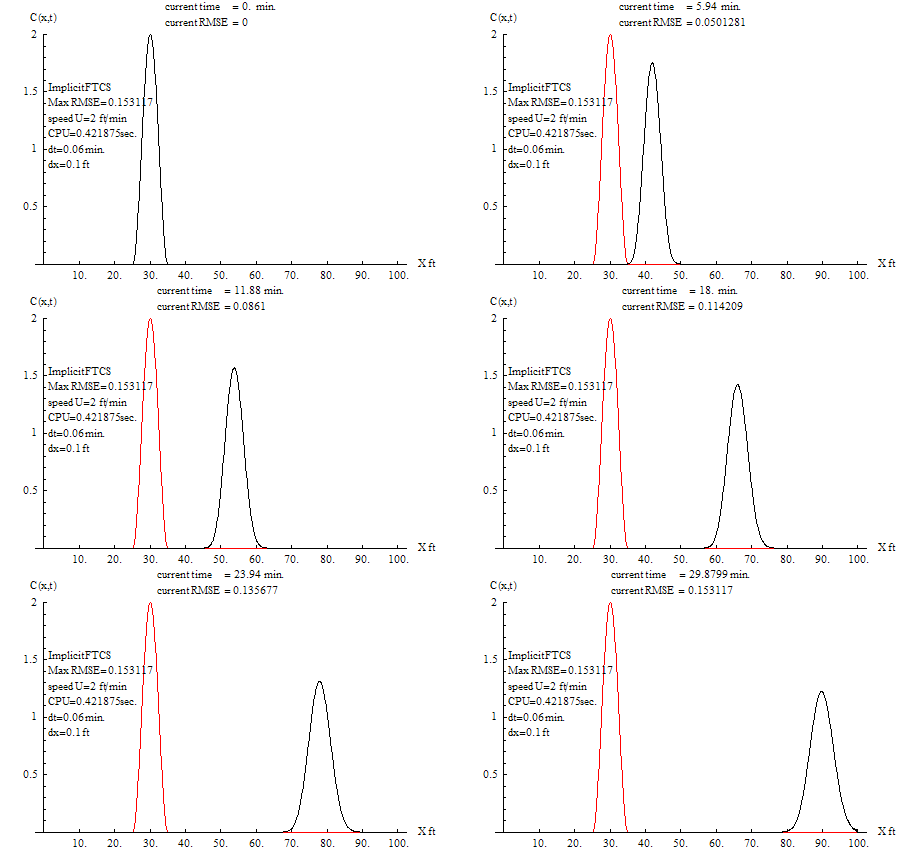
| Implicit FTCS | 0.42 | 0.1531 | HTML | ||
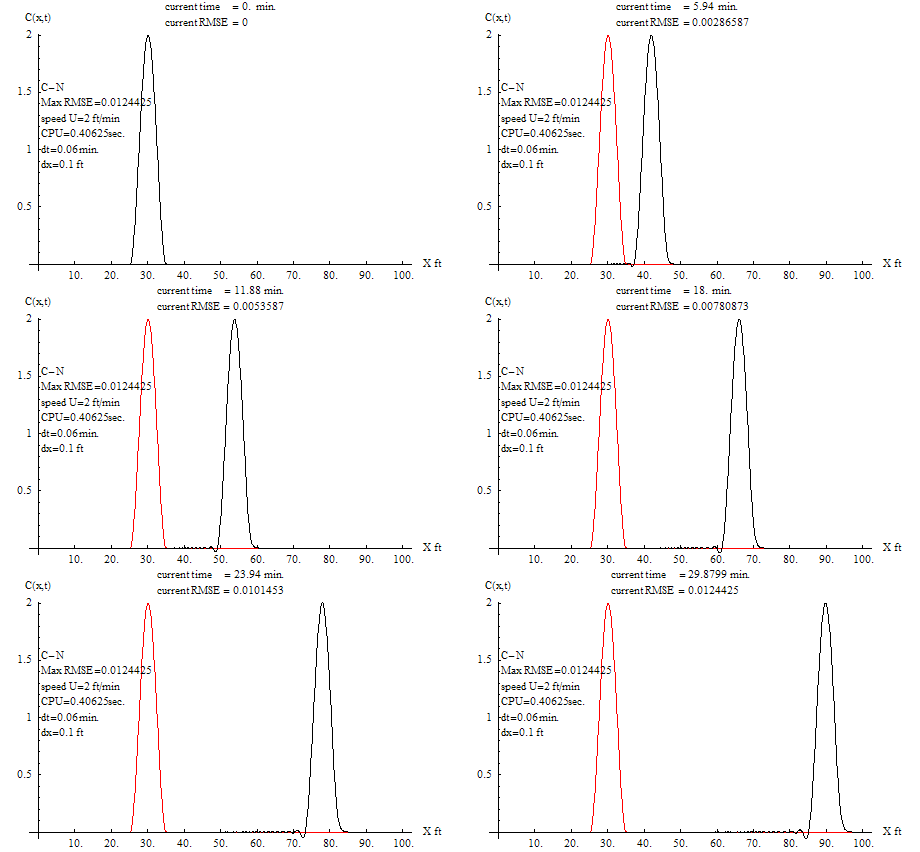
| C-R | 0.41 | 0.01244 | HTML | ||
| U=t/20 | Explicit FTCS | 0.265 | blows up | N/A blows up | HTML |
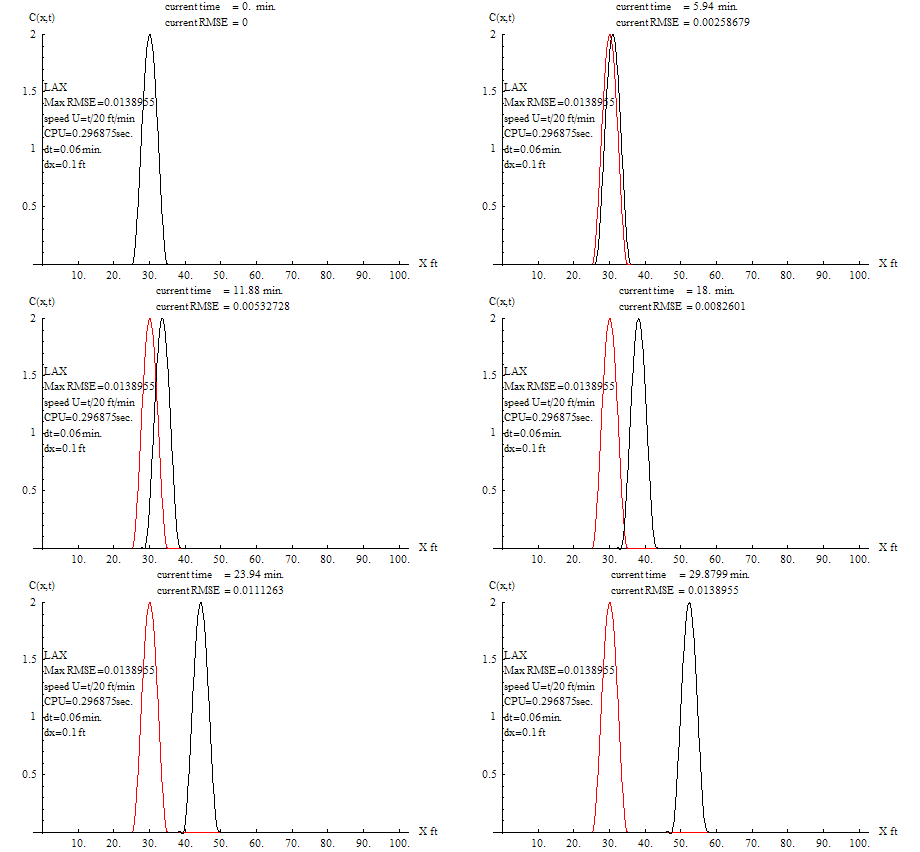
| Explicit LAX | 0.29 | 0.01389 | HTML | ||
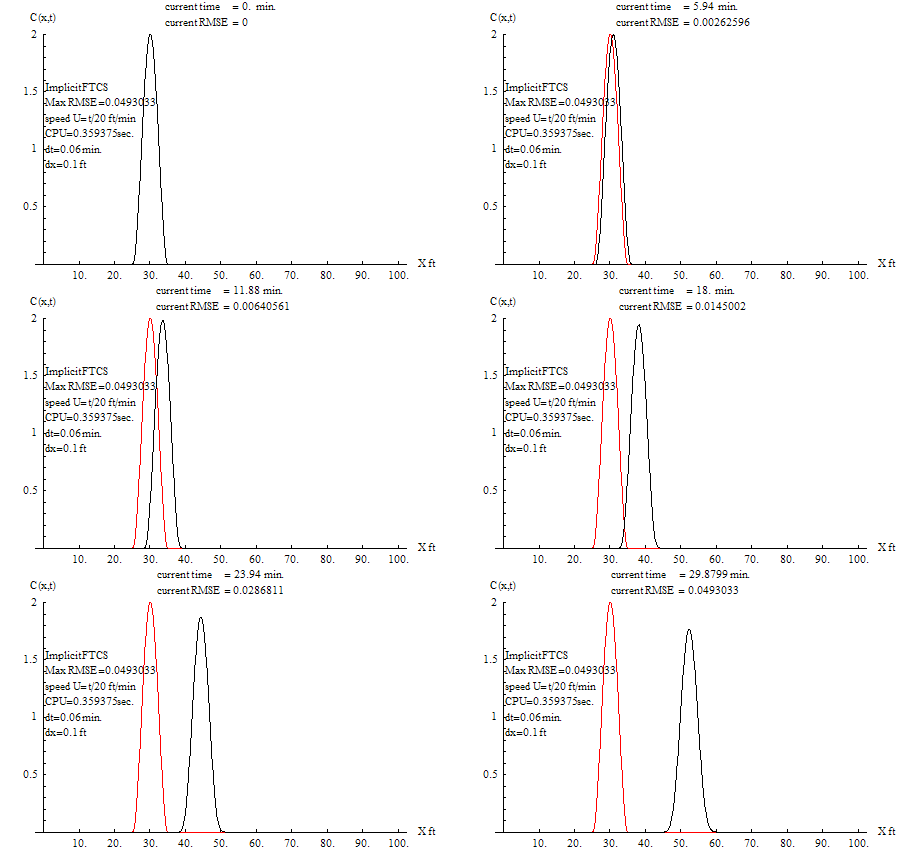
| Implicit FTCS | 0.36 | 0.0493 | HTML | ||
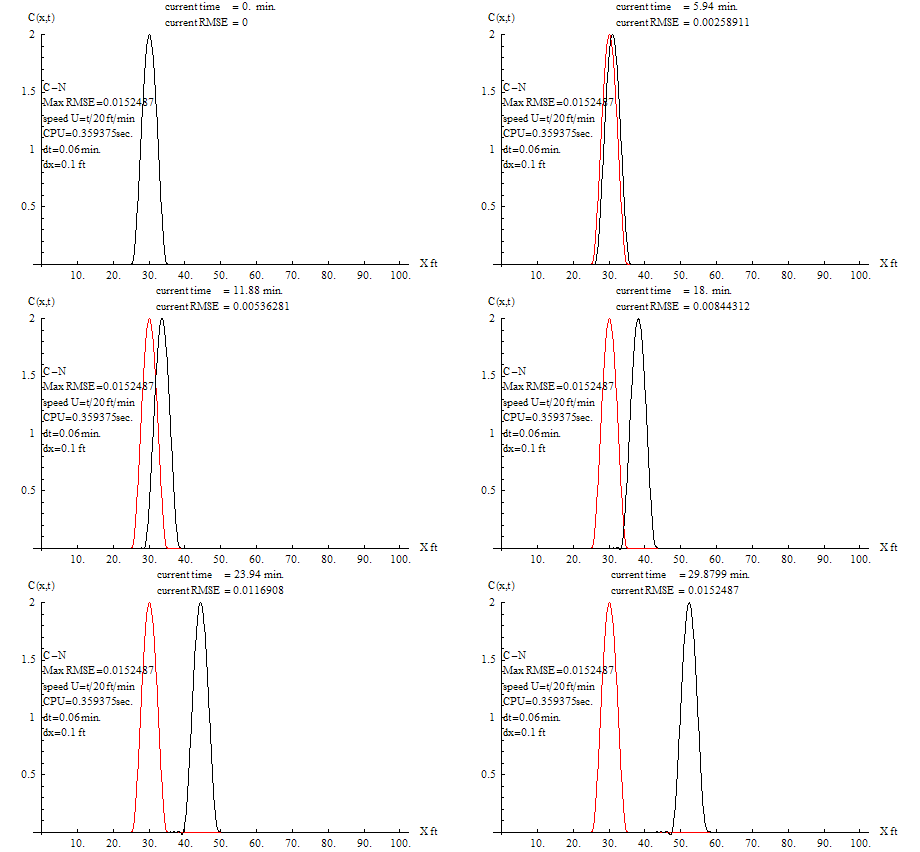
| C-R | 0.36 | 0.01525 | HTML | ||
Notice that the CPU for the implicit method when speed is fixed is now higher than the CPU for the explicit methods. This can be explained as follows: since the time step now is larger than before, the number of times to solve \(Ax=b\) has been reduced. This made the implicit methods faster.
This implies that