2.2.1.1 Solved using first_order_ode_autonomous
Entering first order ode autonomous solver
\[\begin {aligned} x^{\prime }&=-\lambda x \end {aligned}\]
Integrating gives
\begin{align*} \int -\frac {1}{\lambda x}d x &= dt\\ -\frac {\ln \left (x \right )}{\lambda }&= t +c_1 \end{align*}
Singular solutions are found by solving
\begin{align*} -\lambda x&= 0 \end{align*}
for \(x\). This is because of dividing by the above earlier. This gives the following singular solution(s),
which also has to satisfy the given ODE.
\begin{align*} x&=0 \end{align*}
Solving for \(x\) from \(-\frac {\ln \left (x\right )}{\lambda } = t +c_1\) gives
\begin{align*}
x &= {\mathrm e}^{-c_1 \lambda -t \lambda } \\
\end{align*}
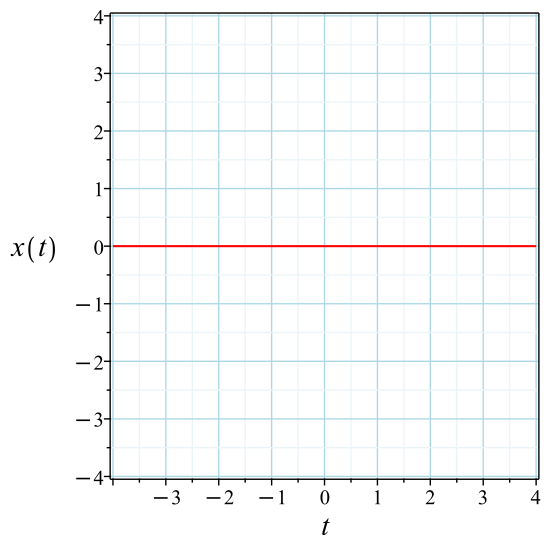
Solutions plot
Summary of solutions found
\begin{align*} x&={\mathrm e}^{-c_1 \lambda -t \lambda }\\ x&=0 \end{align*}